Fear of heights

I am a short man. I have an even shorter girlfriend. Odds are, any offspring would be short. Odds are, their partners would be similar or smaller in height, especially if they are male. Does this mean I am destined to be the heir to a slowly shrinking troglodyte race, my pristine DNA squirted from troll to troll until it degrades to a corrosive, fetid broth? Let’s put the thesaurus away and have a look.

Continue reading

Fourier Vases

In my last blog post I waded through a lot of maths with no pretty pictures to show for it. I’ll redress the balance here and make the pictures extra pretty. The post title alludes to a previous post, and is similar in that I’ll be using mathematics to form interesting 3D objects.

Continue reading

Two Come Along at Once

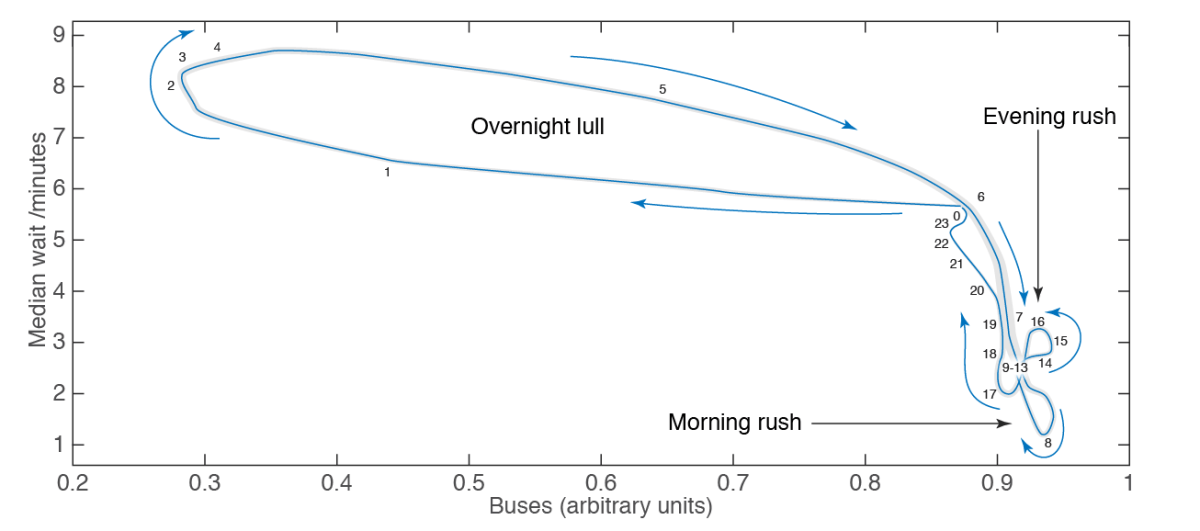
As the old saying goes, you wait ages for a bus and then two come along at once (or more!). Is this true though? My own anecdotal evidence would suggest yes, every single bloody time. However, we love data and maths in this blog almost as much as we hate waiting for the bus, so let’s have a more thorough look at the issue.

Continue reading

A New Perspective

I was playing pool recently, rather badly, and remembered it was much easier to play on a computer, when one can look down on the table from above and see where the balls are more easily. Wouldn’t it be great if there was a way to see this in real time when playing pool? I haven’t done that here, yet, but lets have a look at the steps which might be involved in a solution.

Continue reading

Bayes vs. Paul the Psychic Octopus

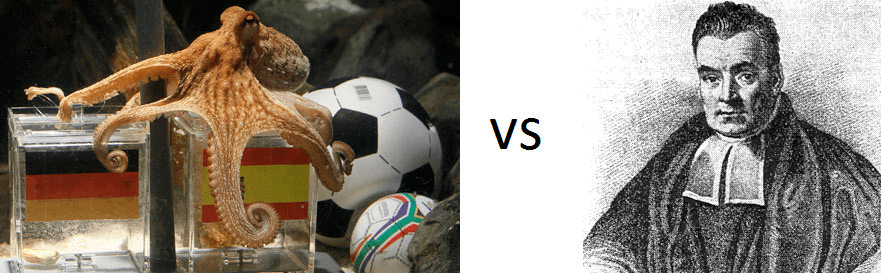
Paul the octopus, for the unaware, was a true hero of the modern age. Combining cephalopodian good looks with a pragmatically sensible German name, he was the star of the show at the Oberhausen Sea Life Centre. That is, however, until his tragic passing in 2010, when the world lost one of its most famous psychic entities. Over the previous two year period, Paul correctly guessed the outcomes of 12 out of 14 international football matches. Does this merit his psychic status? Let’s investigate, following this great example from the excellent book ‘Statistical Inference for Everyone‘ by Brian Blais.

Continue reading

On which shaped planet am I the heaviest?

Continuing on from my last post concerning optimisation and Lagrange multipliers, I came across a neat little paper on the arXiv here, which asks and answers the question: what shape should a planet be to maximise the gravitational force at a given position? This is a fun problem, solved using an extension of the techniques from the last post, namely the use of Lagrange multipliers to optimise a function given some constraint.

Continue reading

Wraptimisation

It’s that time of year again where I am forced to come face to face with my one and only flaw: wrapping presents. Yes, the great staff of Debenhams may as well be superheroes to me, expertly taping seams and tying ribbons while I look on with envious bewilderment. My efforts in comparison look like they’ve washed ashore after six months at sea due to a tragically festive shipping accident. In an attempt to reclaim some Christmas pride then, let’s see if there is anything interesting in the present wrapping process, without, you know, actually doing any wrapping.

Continue reading

Synchrotron Radiation

I was recently at CERN for one of their accelerator schools, learning about new and potentially disruptive plasma-based particle accelerator technology (disclaimer alert – the subject of my PhD). In honour of such a famous institution, I though I’d write about the worst enemy of CERN (and the friend of plasma accelerators) – synchrotron radiation.

Continue reading